Wednesday, December 28, 2022

Teaching White Supremacy: A Review


A Review of Donald Yacavone’s Teaching White Supremacy: America’s Democratic Ordeal and the Forging of Our National Identity


            For many years I’ve been looking for an excuse to write about my observations of race relations in the North and the South, and now I have my excuse. But first, my observations.

            I grew up in Oklahoma City when it was segregated, first by law, and then for several years in spite of the 1954 Brown v. Board of Education decision. My high school was segregated when I graduated in 1966. The first very few Black students would integrate the school in 1968. Other than the week each summer that I went to church camp, my first encounter with Black people was when I went to college in 1966.

            In 1970 a rumor went through my parents’ neighborhood that a Black family would be moving in. One of their neighbors was adamant that would not happen. My parents had built their house in 1958 and had just paid off their mortgage. I should mention here my father was not virulent, but he was a racist in the Southern sense. He did not like Black people in general, but he did on occasion meet individual Black people he liked or at least tolerated. I would compare him to Senator Bird in Harriet Beecher Stowe’s Uncle Tom’s Cabin, who was a full-throated supporter of the Fugitive Slave Act in the Ohio senate, but when faced with Eliza and her son in his own kitchen, helps them escape further into the underground railroad. I asked my father what he would do if a Black family moved in, and he said, “No one who can afford to buy in this neighborhood is going to let their property go down, and that’s all I’m interested in.” As it turned out, there was no Black family moving in.

           I’m going to skip ahead a few years to a visit I made at Christmas in the 1980s. I was out with my sister, and we passed a house in the neighborhood. My sister said, “Now don’t tell Daddy, but a Black man lives there.”  Another time I was out with my brother, who said, “There’s a Black man who lives in that house, but we don’t want Daddy to know.” Eventually, I was out with my father, who said, “I think there’s a Black man who lives in that house. He’s a cop, and he takes really good care of his yard.” And the neighborhood was integrated. It soon became multicultural When we sold the house in 2013, we had competing offers from a Hispanic family and a Vietnamese family.

            I finished my degree in 1970. That summer I took a graduate course taught by Dr. Jere Roberson at what is now the University of Central Oklahoma. If memory serves, he had just moved to UCO from Georgia. We were all steeped in the belief that the South was racist while the North was not. Donald Yacavone and others describe this as the North’s sacred “treasury of virtue” for having fought the Civil War and freed the slaves.

            It would not be long before I saw cracks in this sacred “treasury of virtue.” In 1971 I moved to Columbus, Ohio for a job. I had only been there a few days when one of my coworkers told me she and her husband were going to buy a home in a new development, but she’d found out some Black people were also buying there, so she and hubby backed out of the deal. I guess she thought I, being from Oklahoma and all that, would understand. But I didn’t. I gradually learned that Columbus was quite segregated. My real shock came when I moved to Long Island in 1974. I met the most racist people on Long Island I have ever met. Bar none. We had one Black secretary where I worked, and I don’t know how she did it. People were rude and condescending.

             One incident stands out in my memory. A white family sold their house in Rosedale, Queens to a Black family who moved from London in 1975. The white family’s former neighbors picketed their new home in Westbury. And then, in January 1975, the Black family’s new home in Queens was bombed. As the owner of that home said, “In England, you hear about this happening in the South, but you just don't think it happens in New York City.” So much for that sacred “treasury of virtue.” 

            Lest you think that was nearly fifty years ago and things are surely different now, I’ll direct you to a 41-minute 2021 Newsday documentary titled “Long Island Divided: How Real Estate Agents Treated Undercover Clients on Long Island,” which resulted from a three-year investigation.

(https://www.google.com/search?q=newsday+unequal+treatment&oq=news&aqs=chrome.0.69i59j69i57j0i512j0i131i433i512j0i131i433j69i61j69i60l2.3574j0j7&sourceid=chrome&ie=UTF-8#fpstate=ive&vld=cid:2018caa4,vid:wqN-D3f49fE)      

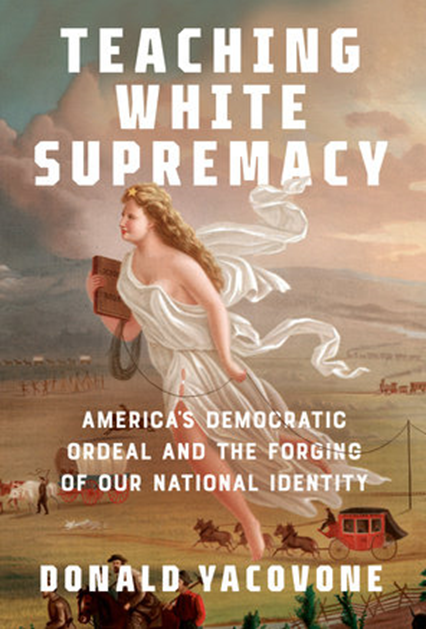
             OK, so now the book. I read a review of Teaching White Supremacy and didn’t know what to expect. I found the cover, which, as you can see, is an 1873 print celebrating westward expansion, railroads, the telegraph, overland mail delivery, and features a woman floating in the air carrying a school book while holding one end of a telegraph line, off-putting. Other than (possibly) the school book, what does any of this have to do with teaching? Fortunately, I started reading the book anyway, and oh, my. The more history I read the less I find I know.

             If a high school student today is taught about slavery and the Civil War at all, they’re taught the North was against slavery and the South was not, which is far from the truth. For one thing, the textile mills in New England, which employed people, including children, in deplorable conditions which were often worse than slavery, relied on cheap cotton, and cheap cotton depended on slavery. And that’s just one example of how the North was just as reliant on slavery as the South. As Yacavone points out, some of the earliest history textbooks, most of which were published in the North, portrayed slavery in a favorable light, and almost every one of them described slaves as having been lucky to have been “rescued” from the wilds of Africa and brought to Our Christian Nation. Slaves were almost universally portrayed as ignorant and of a species somewhat below that of the white race. Even abolitionists bought into that, hating slavery but having no use for the people who were slaves. Even Harriet Beecher Stowe sent most of her escaped slaves off to Africa in the end. In a New York Review of Books review of Kris Manjapra’s Black Ghost of Empire: The Long Death of Slavery and the Failure of Emancipation Sean Wilentz points out white abolitionist societies were not integrated. In short, at the end of the Civil War, a fully integrated society does not seem to have been the goal of anyone. And there were those who wanted to make damn sure it never happened.

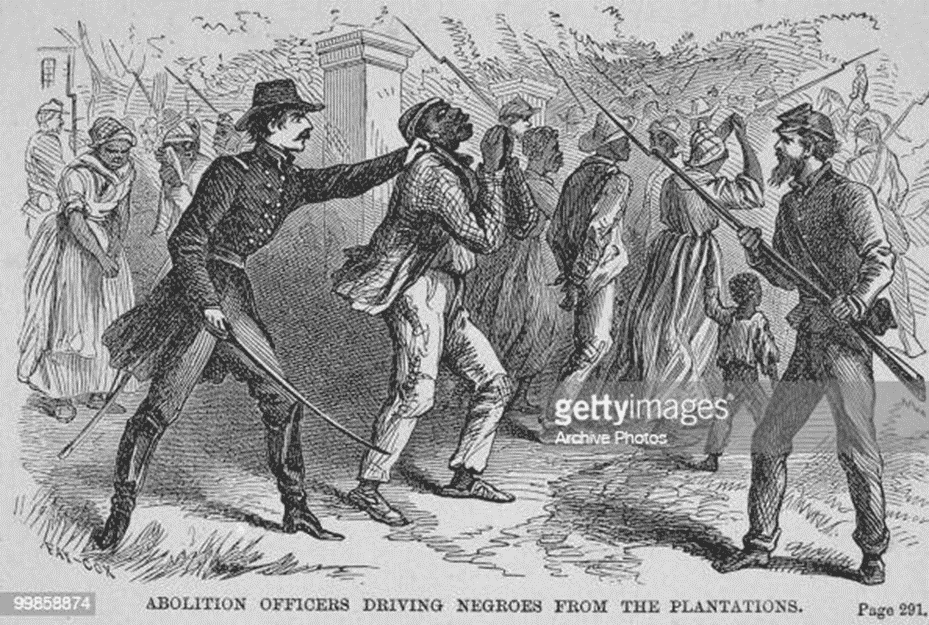
             After slavery ended, the goal of many writers of history was to emphasize how well slavery had worked, with happy slaves, kind masters, and all that. One of the ones Yacavone discusses is John H. Van Evrie (1814?-96), who wrote from the 1850s to 1879 and blamed the Civil War on northerners and abolitionists cooperating with British agents in Canada. In one of the more amusing passages in Van Evrie’s work, published under his partner’s name, Van Evrie wrote that after the Emancipation Proclamation was issued, the North sent an “abolition army” into the South to compel “negroes” to be free to do as they pleased, go where they pleased, and be as lazy and useless as they pleased. Alas, it seems the slave population remained entirely loyal to their masters and refused to leave their plantations. The “invading army” found “the negroes” so devoted to their white masters that Yankee soldiers had to tie them up and threaten to “bayonet them” to force them out of their homes.


            Yacavone takes us through several cycles of teaching white supremacy including the emancipationist challenge, 1867-1883, roughly coinciding with Reconstruction, what he calls “causes lost and found,” 1883-1919 in which he describes the ascendancy of the Dunning School (which was still being taught when I was in high school and an undergrad), “Eugenocide,” the 1920s in which the “science” of eugenics was added to the white supremacist formula, the Lost Cause victorious, 1920-1964 during which Robert E. Lee morphed into a national hero meriting statues North and South and it would have been blasphemy to say anything good about Reconstruction, and finally renewing the challenge, which discusses the impact of the new school of historians, who have actually gone back and reviewed primary documents rather than merely building on the bad history written by previous historians. I was exposed to some of the new thought in grad school at The Ohio State University in the 1970s.

             The book mentions so many texts and writers it is hard to keep them straight. There are many villains, but there are also heroes, among them Albert Bushnell Hart (1854-1943), a Harvard historian who set aside his own prejudice to mentor some of the country’s most influential Black scholars, including W.E.B. Du Bois.

             I do have a couple of minor nits to pick with Mr. Yacavone, both of which appear on page 278. The first is the wall that was constructed in Detroit in the 1930s to secure FHA financing for a housing development was in the Eight-Mile area and was a half mile long. It was not, as Yacavone writes, eight miles long. Second, he says that from 1865 to 1934 the federal government distributed 246 million acres of Western lands to 1.5 million white families. The land was available to Black families as well. My grandparents homesteaded in Colorado, and one of their neighbors was Black. As I said, these are minor, but this country’s treatment of Blacks is bad enough. There’s no need to embellish!

             As I was finishing the book the thought occurred to me that perspectives on the Civil War, slavery, and Reconstruction have gone through several iterations, and who is to say they won’t revert back to Dunning or even Van Evrie? As if reading my mind, Yacavone in his epilogue discuses the January 6, 2021 assault on the Capitol and notes the many Confederate flags that showed up that day. He notes the history wars, the fact that high school history, when it is taught at all, is often taught by coaches who have no training in the subject. As a result a majority of students with a diploma are ignorant of the basic facts of American history and are at risk of being led to believe just about anything about our past. I find that scary. How about you?

             The book is excellent. I get most of the books I read from the library, and there are very few that I like well enough that I want to own for future reference. This is one of those books.  

Sunday, November 27, 2022

AMERICAN MIDNIGHT, A REVIEW OF ADAM HOCHSCHILD'S NEW BOOK


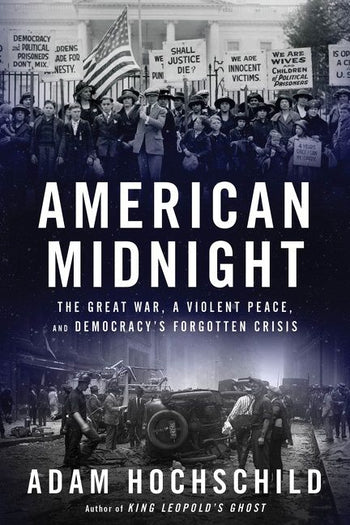
It’s been a while since I’ve posted, but that’s because I’ve been busy, and I’ve not had much to say. A few weeks ago I had a knee replaced, so I had to slow down for a while, which means I had some time to read. For mystery lovers, I recommend Richard Osman’s Thursday Murder Club series. There are three books in the series, of which I’ve read the first two. The book I’m going to discuss today, though, is a history book, Adam Hochschild’s American Midnight: The Great War, A Violent Peace, and Democracy’s Forgotten Crisis.

For me, one comforting thing about being a student of American history is knowing just how much this country has endured and survived gives me hope we’ll get through whatever crisis we’re in at the moment. For example, when I hear someone say they’ll make America great again—or, as I recently heard from a past president, make America great and glorious again, I wonder what they have in mind. After all, it seems to me this country is pretty damn great—and even glorious—already. And I wonder exactly what changes these folks have in mind. And into this breach comes Adam Hochschild to remind me that we’ve been here before. 

In 1917 Woodrow Wilson dragged us into World War I. As Hochschild points out, Wilson claimed he wanted to make the world safe for democracy. Unfortunately, the cost of making the world safe for democracy involved curtailing democracy significantly at home. Laws went into effect stifling freedom of speech. Any criticism of the war could land a person in jail. To enforce these draconian laws, the government effectively deputized civilian men (mostly) on the street, who, as you can imagine, became malevolent Barney Fifes—in one case bugging the barbershop of a German immigrant, who, with several of his customers, wound up in jail for their barbershop discussions. In a few cases, immigrants were lynched for… being immigrants. 

Labor unions were targeted as well. Any time the country goes to war, a lot of money is going to be spent, and, oh my, Hochschild shows how defense contractors took advantage of the situation. But when labor decided it wanted a bigger piece of the pie, business and government turned against them. Violently.

Then, as now, immigration became an issue. Albert Johnson, who would later become notorious for the 1924 Johnson-Reed Act severely limiting immigration, is given a great deal of coverage in this book. Johnson, who attended schools in Atchison and Hiawatha, Kansas, would later move to the Pacific Northwest and become anti-labor and virulently anti-immigrant. Leonard Wood, who had gained some fame in America’s adventures in the Philippines, found himself stuck in Camp Funston at Fort Riley, Kansas rather than being allowed to fight overseas. He decided to make a run for the Republican nomination in 1920 opposing birthright citizenship. Almost a hundred years later, Ted Cruz, a child of immigrants who was born in Canada, would do the same.

Hochschild covers the early career of J. Edgar Hoover and the rise and fall of A. Mitchell Palmer, who would round up aliens and, if at all possible, deport them, preferably to the USSR. Palmer, who saw himself as just what the country needed, was grooming himself to be the Democratic candidate for president in 1920. He issued all sorts of warnings about imminent attacks to occur on May Day 1919. One thing about making predictions that specific is that, if nothing happens, you wind up looking like an idiot. After National Guards, deputized civilians, etc. had been called to protect the streets of America on the fateful day, nothing happened, and the “Fighting Quaker,” as Palmer had been called, wound up being laughed out of any political future and renamed the Quaking Fighter.

The book is 358 pages long, excluding notes, acknowledgements, etc. Hochschild is an excellent writer, although a couple of paragraphs about Wilson’s post-stroke condition appear out of place. As Hochschild points out in his introduction, history books in general skip immediately from the end of World War I to the Roaring Twenties. The eventful years 1917-1921 deserve more coverage. This book is a great place to learn about those dark years.             


Monday, August 23, 2021

 MURDER OR SUICIDE?

A Review of Kenneth Whyte’s The Sack of Detroit


            I read a review of Kenneth Whyte’s The Sack of Detroit: General Motors and the End of American Enterprise in The Wall Street Journal. Barbara Spindel, the reviewer, found the book provocative and vigorous. I was intrigued. My family and I owned many GM products over the years, so I was familiar with what GM offered the public. In fact, in Christopher Buckley’s 2007 Boomsday, a character commits suicide by driving a 1957 Cadillac over a cliff. In trying to make the suicide look like an accident, the case is made that the gearshift fell out of Park and into Drive. When it was pointed out that the gearshift would have gone from Park to Reverse instead, all that was said was, “You would have thought so.” I knew that in 1957 the GM shift sequence was Park, Neutral, Drive, and Reverse, so a fall out of Park to Drive was plausible. I wrote the author, who said no one else had caught that. By the way, Christopher Buckley is, in my opinion, a hell of a lot better at writing than his father was. At any rate, we’ll get back to my and my family’s experience with GM later, but know in advance not one  of us currently owns a GM product.

            Whyte starts off by saying, “This is a book about America in the 1960s, a notoriously hectic time, and it felt that way in the living.” Whyte was born in August of 1960, so it’s not clear how he knows the 1960s “felt” hectic. I lived through them, and while a lot happened during that decade, a lot happens in every decade. The 1940s, for example, involved World War II, which could also have been categorized as “notoriously hectic,” especially for those involved in the fighting. The 1960s have been romanticized by the aging activists of that era, some of whom now teach college courses about the 1960s, but newsflash! every decade had its activists. I think the 1950s have been shortchanged, but that’s just my gripe, and I’ll save that for another time.

            The reader really doesn’t learn much about Whyte from the very brief writeup about him on the dustjacket, but a Google search reveals he’s something of a conservative writer and activist in Canada. I’d guess he’s something of an Amity Schlaes, attempting to resuscitate reputations of presidents who are generally considered failures (Coolidge for Ms. Schlaes; Hoover for Mr. Whyte) and revise history rightward. Had I known that in advance I probably would not have read the book, but once I started the book it was like a bad accident. I couldn’t avoid looking to see just how bad it was going to get. And it got pretty bad!

            While Whyte starts out on an enjoyable trip down memory lane, discussing how the automobile was resisted before becoming a necessity, he soon veers into victim territory. By the time he gets to the 1950s, it seems there are barbarian worms assailing the perfect apple that was GM. People are actually becoming concerned about automobile safety. Until then the industry had successfully blamed accidents primarily on speeding and drunk driving. But some studies were showing that car occupants were killed or seriously injured when they were thrown into steering wheels and dashboard controls and even out of the cars. Personal injury lawsuits were being filed, and some were being won. What’s an industry to do? Additionally, cars were becoming so large in the 1950s that some people wanted something more manageable and were buying imports—most notably VWs. To get to the meat of the book, GM decided to make a car to compete with VW, and the Corvair was the result. Whyte is convinced the Corvair was a good product (and he cites one case, decided by one judge, as evidence), but as we know, Ralph Nader wrote Unsafe at Any Speed in 1965 (when Whyte was five years old), and things went downhill from there. GM might have been able to come out undamaged by the investigation of the Corvair, but they made the mistake of investigating Nader in search of mud. GM wasn’t successful in finding mud, although Whyte is convinced there was some, but it just wasn’t found. At any rate, at that time the American public had a strange belief that private lives should for the most part be private. (I know. How quaint!) GM’s investigating Nader did not go over well and resulted in GM’s paying Nader $425,000 (equivalent to more than $3.5 million today) for damages. Whyte isn’t sure, but he says the death of Alfred P. Sloane, a former president and CEO of GM, at the age of 90 in 1966 could have been caused by Ralph Nader! Additionally, some people were beginning to question industry practices in general, and—horrors!—writing books. Whyte credits or blames such offerings as Rachael Carson’s Silent Spring, Jessica Mitford’s The American Way of Death, Betty Freidan’s The Feminine Mystique, Michael Harrington’s The Other America, and Jane Jacobs’ The Death and Life of Great American Cities as examples.

            By the time I got to this part of the book, I wondered why Whyte wrote this book. After all, he doesn’t even seem sure of what cars GM made. He lists Plymouth as a GM product more than once (when he discusses safety improvements in a 1937 Plymouth, I don’t know whether he means Plymouth or an actual GM product), and never mentions the LaSalle, positioned between Buick and Cadillac between 1927 and 1940. But I trudged on.

            GM was damaged by Nader, but “fiscal excesses” of the Johnson administration also damaged GM, causing it to pursue a new product, which would “have to be produced on the cheap, with smaller amounts of cheaper materials, less distinctiveness in design, more sharing of designs and parts with other cars, and more efficiency rather than greater care in assembly.” The Vega was the result. Cheap does not always save money. There were massive recalls for all sorts of problems, and the car’s aluminum engine was notoriously awful.

            Whyte dismisses the benefits of safety legislation passed in 1966, and perhaps he has a point that regulators concentrated on passive restraints (air bags, etc.) rather than on seat belts, but to say, as he does, that “The fact is Ralph Nader and the federal government harmed the cause of safety” is, I think, a bit of a stretch.

            The answer to the question I asked myself several times while reading this disaster finally comes in the Epilogue, titled “The End of American Enterprise,” in which Whyte compares the evils committed against GM to what he perceives as overkill regarding regulating Purdue and other pharmaceutical companies. How penalizing Purdue for overselling opioids and understating their dangers is a bit of a reach, as is claiming such actions mean “the end of American enterprise” is a bit of a stretch given we live in a country that has in the not too distant past given us Microsoft, Apple, Amazon, and a host of other successful companies.

            Now, as promised, a brief history of my and my family’s experiences with GM.


            After war was declared in Europe my father bought a 1939 Chevrolet coupe. He was hired by the US Army Corps of Engineers to work on a project that took him first to St. Louis, where he met my mother, then to New York followed by Santa Fe and Oak Ridge, Tennessee and finally back to St. Louis after the project brought an end to the war, which also meant an end for their jobs. The Chevy had served them well, but they wanted a newer car, so my father signed up for a 1946 Buick. As it turned out cars were in high demand at the time—none had been built in the past four years, and it was um, expected, that in spite of price controls, some money would be passed under the table in order to insure delivery. My father didn’t know that, and as a result he spent the rest of his life joking that he just knew one day GM would call and tell him that Buick was ready.

What my father wanted


What we wound up with

            I came along, followed by the older of my sisters, and we outgrew the coupe, so in 1950 my parents bought a 1948 Plymouth, which, contrary to what Whyte thinks, was not a GM car. Three years later they bought a 1953 Pontiac, which was one of my favorite cars.

Just about my favorite of the cars we owned


Probably the worst car we ever owned

    A couple of years later we became a two-car family when my father got a deal on a 1951 Buick from a cousin. It turned out not to be a great deal after all. In 1958 we moved into a newly built house with a two-car garage and wound up with a 1957 Oldsmobile in one side and the old reliable Pontiac in the other. The Oldsmobile was one of the worst cars we ever owned, and in a triumph of hope over experience, it was followed by a 1961 Oldsmobile, which was an improvement, but considering the 1957, that’s not saying much. 


Something of an improvement.

My father’s company let him drive a 1962 Ford, which he eventually bought. The Pontiac was parked at my grandmother’s house supposedly for me when I was old enough to drive, although when a friend of mine and I started fixing it up to get it running a few years later, my parents promptly sold it for $50, and the Ford was foisted on me. No, it wasn’t given to me. 


What I wanted to buy (with my own money, by the way)


What I wound up with

I’d found a 1954 Pontiac I wanted to buy, but I wasn’t 21, so I couldn’t buy a car on my own. My folks wanted a new car, so my choice was if I wanted to buy a car, I could buy the Ford. Or nothing. (I had several paper routes, so I was earning and saving money.) The Ford didn’t last long. I had a few junkers after that, but when I was finally old enough to buy a real car on my own, I bought the first of two VWs. A few years later, the first gas crisis hit. People remember those times as awful, and for a while there was a gas shortage, gas lines, odd and even fill up days and so on, but the price of gas went from about 32¢ a gallon to 57¢ a gallon, which in the overall scheme of things was manageable, at least for me. Large cars were cheap, and I bought a one-year-old Buick Electra which I took with me to New York, Los Angeles, Boston, and San Jose, where I sold it and bought a Honda Accord, which I hated and sold for a profit and bought a 1974 Pontiac, which I brought with me to Kansas City the first time I moved here.


The deuce and a quarter.

            The job I had at that time required me to travel, and I was impressed with the Buick Regals and Oldsmobile Cutlasses I rented, so I bought a new Regal in 1980. It had a V6, and it was basically a good car. I took it back to the dealer several times because parts of the car didn’t quite fit together well, and the carpet in the trunk didn’t really fit. I kept taking it back until one day I noticed it sitting in the parking lot of a local fast food joint where I’d gone to get coffee while I waited for the car. When the car left I walked back to the dealership, and the customer service manager said it was all fixed. When I asked how that was possible, given I’d just seen it in the fast food joint’s parking lot, he said, “Look. You didn’t pay for a perfect car.” This was news to me, but it did make me wonder what the purpose of buying a new car was if it weren’t going to be perfect when it came off the showroom. That car was totaled in Austin, Texas when another driver ran a red light. 

"You didn't pay for a perfect car"

        I went through a couple of junkers and finally bought a 1986 Oldsmobile after a move back to San Jose. That car was OK, although it did have computer problems. I brought it back with me to Kansas City and after 9/11, when car makers were offering no down and no interest loans, I saw a 1990 Buick station wagon on a dealer’s lot. When I expressed an interest, the dealer said, “Oh, no one will make a loan on a car that old.” After talking to the car’s previous owners, a wealthy couple who said they’d only used the car to go to their place in Florida in the winter and their vacation home in Michigan in the summer, I decided to make a lowball offer, which was accepted. My mother died unexpectedly in 2003, and I made biweekly trips to my father’s home in Oklahoma City for some time afterwards. The car’s air conditioner stopped working, and I took the car in to have it fixed. I will never forget how frustrating this experience was. Actually, the air conditioner was fine, but the car had a touch sensor that failed. Now, this was a sensor that had been used on Chevrolet, Oldsmobile, and Buick station wagons, and GM no longer stocked the part! Because of that, the air conditioner could not be fixed. I even asked my parent’s trusted mechanic if he could find a used part. He couldn’t. When I expressed my frustration to the dealer, he said, “Well, that car is 13 years old.” GM was admitting, I suppose, they didn’t plan on their cars lasting 13 years. At any rate, I told myself people had survived without air conditioned cars for years, and I could, too, but the summers here and in Oklahoma can be brutal!


"Well, that car is 13 years old."

            My father died in 2005, and I inherited the 1989 Oldsmobile he’d bought after seeing my 1986. I also bought another 1989 Oldsmobile from a friend who was relocating. Eventually the second one pretty much fell apart, and I sold the first one and the station wagon and bought a 1996 Oldsmobile, which was one of the worst cars I’ve ever owned. When the brakes failed the second time, I decided that was it. I’d taken a look a Kia Souls and liked how relatively easy they were to get into and out of. The day after I had the brakes on the Oldsmobile fixed, I drove it to a Kia dealership and bought a Soul. That was more than seven years ago, and other than routine oil changes, tire rotations, etc., the only thing I’ve done to that car is replace the battery, and I did that just because it was seven years old, and it gets cold here in the winter.

I think this is the best car I've ever owned. 

            My younger sister was for a while the lone holdout, saying she would always buy only GM products, since that’s what our parents did, but she now has a Toyota Rav4.

            I think it’s safe to say I and my family gave GM more chances than we should have in order to stay loyal, but in the end, GM just didn’t stand up to competition that was more comfortable, more reliable, and more affordable, especially when taking into account maintenance and repairs.

            Mr. Whyte can make the case that GM was a victim of bad faith all he wants, but in my book, GM’s downfall was self-inflicted. It wasn’t murder, it was suicide.

A note to my readers. This is a post I've been working on for a while, and I'm having some trouble with Blogger.com on getting the spacing and alignment right. Alas, classes started up today, and I've got to get to work on those, so I'm going to pot this as is. Enjoy!

Saturday, July 31, 2021


 The Wyatt Slaughter House

          A few years ago, I read the home of Wyatt and Edna Slaughter in Oklahoma City had been restored and had become a Bed and Breakfast. Man, did that bring back memories! My 55-year high school reunion is coming up at the end of September, and I thought it would be great to stay in the house I used to visit and that porch that was one of our favorite hangouts in the summer. Alas, the house is now an airbnb and offers more space than Dan and I need at a price beyond my budget. The new owner, Doris Youngblood, said if the property is not in use when we’re in town she will show us around.

            When I say the front porch was one of “our” favorite hangouts, I mean Joe Baumhaft, Howard Thompson, and me. Joe, who died suddenly a few weeks ago (it’s a hazard of getting old), is a story in himself and may be the topic of a future post, but Howard was how I got to know Mrs. Slaughter and the Slaughter house.

            When I went to college in the fall of 1966, I left a segregated life. My high school, Northwest Classen, would not be integrated until 1968. The home my parents built in 1958 was in a segregated subdivision. In 1970 a rumor went through the neighborhood that a Black family was going to move in. The daughter of our next-door neighbors went through the neighborhood performing what she must have thought was a reprise of Paul Revere, although it was not the British that were coming. I tried to talk her down to no avail. My parents had just paid off their house, and I asked my father what he planned to do. He was no liberal, but to his credit, he said, “No one who can afford to buy a house here will just let it go to pot.” Then he simply went back inside leaving the neighborhood Paul Revere with her mouth hanging open. And that was the end of that.

            My whole life was segregated except for the one week a year I went to church camp, where I came into contact with the children of middle-class Black people and occasionally their parents if they were counselors. One of the parents, Don, was extremely patient with me when I asked him questions about his family and his life, although I’m sure he was rolling his eyes internally.

            At any rate, Howard was different. He was older, had been in the Army, and he was from Boston and had the Brahmin accent. I did not know then, and I do not know now what his relationship to the Slaughters was, but for a good part of the time I knew him, he lived in the house with Mrs. Slaughter. 

            Although Joe and I were white, since we were friends of Howard’s, Mrs. Slaughter tolerated us and even brought us iced tea when we were hanging out on her porch. I had no idea until a few years ago how rich and how important in Oklahoma history the Slaughters were. When you’re young, you just accept things without examining them too closely. Of course I knew the house was huge and was on many acres. What I didn’t know was Mrs. Slaughter’s husband, Dr. Wyatt Slaughter, had come to Oklahoma Territory in 1903 and began buying land. He eventually owned more land than any other Black person in the state. In his segregated times, he was a doctor with many patients. In his 2007 Ralph Ellison: A Biography, Stanford University professor Arnold Rampersad writes that Ellison’s mother lived in a boarding house owned by Mrs. Slaughter’s parents, Jefferson Davis and Uretta Randolph, and Dr. Slaughter delivered Ralph Ellison, who remained close to the Slaughter family and flew to Oklahoma City for Mrs. Slaughter’s funeral when she died unexpectedly. Dr. Slaughter owned a great deal of land in downtown Oklahoma City and built several large office buildings. He died in 1952, long before I came on the scene. When I knew the Slaughters, his son, Wyatt, Jr., ran the business. I’ve written about status deprivation in the past, and the Slaughters, possibly concerned about reprisals for having done too well, kept a very low profile. If you were to meet Wyatt, Jr. on the street, you wouldn’t have known he had two nickels to rub together. Mrs. Slaughter drove a well-maintained 1956 Mercury 2-door until she died in 1969. When I first met Howard, he had a dark green 1964 Mustang. It had six cylinders, and he wanted to upgrade. I was there once when he told Mrs. Slaughter he was thinking about buying a Cadillac, and her face registered horror. I’m sure when they were alone, she elaborated, but all she said in front of us was, “Howard, we don’t do that.” Well, he didn’t buy a Cadillac, but he did buy a Jaguar like the one that was in Mad Men, and it proved just as reliable as the one on the TV series.

            Howard could be very persuasive. In 1968 he talked me into going to a George Wallace rally with him at the Oklahoma City fairgrounds because--surprise!—he was concerned about being a Black man alone in that crowd. It was an experience. I still have the handouts from that rally. As we were leaving, Wallace told Howard he looked like an intelligent young man. He looked at me like I was crazy. I don’t think I ever told my parents about that adventure.

            My grandmother went to spend much of the winter of 1969-70 in Phoenix with one of her nieces, so I was staying at her house when one night Howard called in tears. Mrs. Slaughter had died at a party she’d gone to with friends. He was distraught. I’m not sure when Howard moved from the Slaughter house, but it was some years later. I moved to Columbus in 1971, and when I came to visit my family, he was there. As I recall, he closed off her bedroom area, so I never saw that part of the house. My life became peripatetic with stops in New York, Los Angeles, Boston, San Jose, Austin, and Kansas City. Howard and I lost touch. I understand he moved back to Boston, but I’m not sure when or where in Boston he moved. It happens.

            What I remember about the house is it had murals in the dining room. The house was built in 1937, and the story I heard was the murals were painted by out-of-work, possibly WPA, artists. I also remember the house stayed cool in the summer even though it was not air conditioned. It was built on high ground and caught the breeze.

            The Slaughter house is at 3101 NE 50th St., Oklahoma City, OK 73121. It is now known as The Mansion and is on the National Register of Historic Places.


Monday, July 19, 2021

             It’s been a while since I posted. I took a class last semester titled “Race and Violence in 19th Century Literature.” It was the most difficult class I’ve ever taken (and that covers a lot of years) both in terms of the amount of work involved and the psychological effect of the violence involved. I was in a group that took on Rape and Lynching. Among other things, we had to go back to primary sources, including newspapers of the day, for coverage of the lynchings. The final product was a PowerPoint presentation. I’d never used PowerPoint, but I managed to learn, so that was a good thing. As for the amount of work involved, that was not really a problem. With Covid restrictions, there wasn’t much going on anyway. But the violence! I knew Blacks had been lynched. But I didn’t have a concept of what that involved. In many cases the lynchings happened without a trial, without any evidence, were announced in advance, special trains were run to the events, spectators often numbered in the thousands, and most horrifying to me, souvenirs of the event were sold to those attending. 

  
  In the case of San Hose it was proudly reported that before his lynching by fire, Hose was “deprived of his ears, nose, and other portions of his anatomy.” After the lynching, “Before the body was cool, it was cut to pieces, the bones were crushed into small bits, and even the tree on which the wretch met his fate was torn up and disposed as souvenirs. The negro’s heart was cut in several pieces, as was also his liver.” “Small pieces of bone went for 25 cents, and a bit of liver, crisply cooked, sold for 10 cents.” Two thousand people attended. After the lynching it was discovered that Hose had not committed the rape he was accused of, but a good time was had by all.


            At the end of the semester, I resolved to read some mindless brain candy to get this and other images out of my mind. I highly recommend Carl Hiaasen's Squeeze Me if you're in need of some really good satire. In the class I was introduced to Albion Tourgee, a white carpetbagger who settled in North Carolina and witnessed Reconstruction first-hand. He definitely deserves to be read today when the Reconstruction era is being revised to suit whatever biases non-historians want taught in public schools.

            At any rate, the following is my term paper. Enjoy.

Status Deprivation and Violence

            Colonel Comfort Servosse: Sir,--You hev got to leeve this county, and the quicker you do it the better fer you ain't safe here, nor any other miserable Yankee! You come here to put n- over white folks, sayin as how they should vote and set on juries and sware away white folks rites as much as they damn please. You are backin up this notion by sellin of em land and horses and mules, till they are gittin so big in their boots they cant rest. You've been warned that sech things wont be born but you jes go on ez if thar want nobody else on arth. Now, we've jes made up our minds not to stan it enny longer. We'be been and larned yer damn n- better manners that to be a ridin hossback when white folks is walkin. The regulators here met, and decided thet no n- shant be allowed to own no hoss nor run no crop on his own account herearter. And no n- worshippin Yankee spy thet encourages them in their insolense shel live in the county. Now, sir, we gives you three days to git away. Ef you're here when that time's over, the buzzards will hev a bait thats been right scarce since the war was over. You may think wes foolin. Other people hez made thet mistake to ther sorrer. Ef you don't want to size a coffin jest yet you better git a ticket thet will take you towards the North Star jes ez far ez the roads been cut out.   

                                                                                                                    By order of

                                                                                                         The Capting of the Regulators 

            This was the anonymous note Albion W. Tourgee’s protagonist, Comfort Servosse, found on his doorknob the morning after some “disguised ruffians” had invaded the freedmen’s settlement Servosse had established on some surplus property. The freedmen had proven themselves capable of planting and harvesting crops, making a profit, buying horses, mules, and paying off their houses. They were becoming self-sufficient, and that was an outrage to those who considered Black people good only for menial work. The ruffians had beaten and outraged some of the residents, stolen two horses, and cut and mangled other horses.

            Black people prospering, and especially Black people becoming more prosperous than white people was not going to be tolerated. No Black person was to ride a horse when there were white men walking.

            In his 1944 An American Dilemma, Swedish sociologist Gunnar Myrdal wrote, “The South gives indication of being afraid of the Negro. I do not mean physical fear. It is not a matter of cowardice or bravery; it is something deeper and more fundamental. It is a fear of losing grip upon the world. It is an unconscious fear of changing status.” Anxiety about changing status, sometimes voiced today as “the great replacement,” is still being experienced and is by no means limited to the South.  

            I’m going to focus on that anxiety and the violence that results when a formerly dominant segment of society anticipates threats to its cultural entitlement and fears a loss of power and rank, or what William Tuttle called “status deprivation” in his 1970 Race Riot: Chicago in the Red Summer of 1919. Status deprivation is the perception that a person or a class, race, or group of people has moved above its station, or done better than the aggrieved party believes that person or group has a “right” to. Those who see people they consider inferior doing better than their self-appointed betters become resentful. I’ll come back to A Fool’s Errand, which is full of status deprivation, later, but first I want to look at an example from antebellum literature.        

            In Harriet Beecher Stowe’s Uncle Tom’s Cabin, when George Harris’ master learns that George has invented a hemp cleaning machine and is held in high regard by the man George is hired out to, he takes George home and gives him the dirtiest and most menial jobs he can find. The master and his son drown George’s dog. George’s offense was he was intelligent and appreciated, and George’s master resents the high regard George has earned in his employment. He’s determined to keep George “in his place.” Further, George’s master only sees that he has invented a machine that will save work. “O yes! –a machine for saving work, is it? He’d invent that, I’ll be bound; let a n- alone for that any time. They are all labor saving machines themselves, every one of ‘em.” George’s master has no appreciation for making work easier—he does not work and has little regard for those who do.

            Jeffrey Glossner, a Ph.D. candidate at the University of Mississippi, writes on the Humanities and Social Sciences Online website “Elite southerners justified slavery as a social system that elevated all whites above black enslaved laborers. Therefore, the presence of a large class of poor white people in the South created a fundamental problem for the southern ruling class as it sought to shore up slavery in the face of antislavery attacks.” As Clotel author William Wells Brown’s character Rev. Snyder explains to Carlton, the visitor from the North, poor whites lived in squalor because “no white man is respectable in these slave states who works for a living.”

            This aversion to work among many in the old guard carried over even after the Civil War and Reconstruction. Edward L. Ayers, a professor of history at the University of Virginia, writes in his 1992 The Promise of the New South that the older generation looked on any sign of industriousness in the youth of the day with alarm. Ayers quotes Henry Waring Ball of Mississippi saying his nephew had “gone to work” after asking his mother to let him help a friend deliver newspapers. “We laugh over it, but if it is an indication of his character, it is not a laughing matter. Few boys at 7 years old would voluntarily hunt up work and become money makers—even at 25 cents a week. I know it would horrify either one of his grandfathers, beyond all measures, but times change and we with them, alas!” (Kids these days!)

            The younger generation was equally frustrated with their elders. S. D. Boyd, Jr., of Virginia complained in his diary, “’Come day, go day, God send Sunday’ is more the motto of the free and go easy life of the Boyds.” His parents had not been “reared up to hard work. They had their slaves, their servants, etc., were not accustomed to it in their youth, and hence cannot understand hard business. They take things easy, love to talk, to eat and to sleep but it does not come natural to them to come down to hard work.” They were “a Procrastinating People… a people who do not feel altogether the great business importance of keeping an engagement.” We see this generation gap in A Fool’s Errand when, in Chapter 15, Squire Hyman visits the Servosse home and tells Mrs. Servosse that Jesse, the squire’s son, “is going in to work as if he’d been raised to it all his life.” Jesse came home from the war, and unlike many Southerners, accepted the South’s loss and got on with life. He hired his father’s former slaves and worked beside them in the fields. He was bringing in “two as good crops as we’ve had on the plantation in a long time.” He was working and paying the family’s former slaves a fair wage. The Ku Klux Klan disapproves and whips him, causing him to flee to Indiana. His voting the wrong way was the final straw, but I believe his industriousness and treating his Black employees well were also factors. 

            Tom Delamere in The Marrow of Tradition is yet another example. He’s given an allowance by his grandfather and runs up dinking and gambling debts. Although he looks down on Lee Ellis, Major Carteret’s editor, he hits him up for small loans, which he forgets to repay. He even borrows from Sandy Campbell, his father’s trusted servant. Eventually he’s hopelessly over his head in debt; even then the thought of getting a job never enters his mind. Instead, he decides to rob Peggy Ochiltree, his intended’s aunt, and frames Sandy Campbell for the crime. Peggy Ochiltree dies during the robbery, and Sandy is very nearly lynched.

            Returning to A Fool’s Errand, we see numerous examples of status deprivation. In Chapter 27 we meet Bob Martin, “an industrious and thrifty blacksmith,” who has more business than he can handle and understandably declines more business from Michael Anson and his son because they don’t pay their bills. After all, when he can do work that pays, why do business with people who won’t pay? Bob Martin has done very well, and bought a house and a lot. The Ansons evidently resent having to pay a Black man for work they could in the not-too-distant past have had slaves perform. The Ansons rounded up some Ku Klux Klan help and whipped Bob Martin for being “too dam smart!” In Chapter 28 we find “three colored men” who were “whipped by the KKK… they had been sassy: the true reason is believed to be they were acquiring property, and becoming independent.” In another case, “two colored men were hanged. They were accused of arson; but there was not a particle of evidence of their guilt: indeed, quite the contrary; they were men of good character, industrious, and respectful.” Another, “James Leroy was hanged by the Ku-Klux on Tuesday night… . He was accused of having slandered a white woman. The truth is he was an independent colored man, who could read and write, and was consequently troublesome on election day, by preventing fraud upon his fellows.” In short, these Black men were punished as examples for those who might pose a threat to white supremacy.   

            Ida B. Wells’ Southern Horrors: Lynch Law in All Its Phases and The Red Record are also stuffed with examples of violence precipitated by status deprivation. I’m also going to draw on Ida B. Wells: A Passion for Justice, a 1989 documentary available on Kanopy. Eric Foner was one of many participants in the documentary’s production. In 1889 Will Stewart, Calvin McDowell, and Thomas Moss, all of whom were friends of Wells, opened a grocery store near a white grocer in Memphis. The store did well, especially with black shoppers. In 1892 the three grocers were lynched. The white grocer complained he had lost many black customers to the new store. How dare those Blacks be successful a mere 24 years after having been slaves?

            The Black community of Memphis was stunned. In Southern Horrors, Wells urges economic action, saying, “The appeal to the white man’s pocket has ever been more effectual than all the appeals ever made to his conscience.” She told the Black people of Memphis they did not have to put up with lynchings and suggested they move to areas such as Kansas and the newly-opened Oklahoma Territory. Six thousand of them did, which hurt many white businesses. Many ministers took their entire congregations with them. All-Black towns were sprouting up in Kansas and the Oklahoma Territory. Sadly, when Oklahoma became a state in 1907, Jim Crow laws were adopted.

            Wells also urged Black people in Memphis to boycott the newly-installed trolley system. Six months after the lynchings, the secretary and treasurer of the city railroad company came to Wells at her paper, The Free Press to ask for help getting Blacks to use the system. They believed Blacks were avoiding the trolley because they were afraid of electricity. Evidently the possibility that Blacks would actually take any action in response to these murders was beyond white comprehension. Wells advised her readers to keep up the pressure. Shortly after this, while Wells was in Philadelphia, the offices of the Free Press were destroyed and she was advised not to return to Memphis.

            In “An Indiana Case,” Wells writes of Allen Butler, a wealthy Black man, who was lynched because the mob could not reach his jailed son, who had been in a consensual relationship with a white servant employed by Butler. Here we have a man who triggered status deprivation by being wealthy and having a white servant. I hate to dwell on the obvious, but if a white man’s son had been involved with a Black servant, consensual or otherwise, that would have been considered par for the course.

            The entire Wilmington massacre, which inspired Charles W. Chesnutt’s Marrow of Tradition, was the result of status deprivation. Many books have been written about the populist movement in the 1890s, among them Lawrence Goodwyn’s 1978 The Populist Moment and Michael Kazin’s 1995 The Populist Persuasion, which was revised and updated in 2017 to reflect recent events. It’s difficult to describe that movement adequately in a short paper, but I’m going to attempt a coherent summary. After the Civil War a period of industrialization began, which concentrated wealth and economic power. Those with this increasingly concentrated power used it to drive commodity prices down and costs, including the costs of shipping goods by rail, up. The only way for farmers to keep farming was to borrow money. The era was one of deflation, so the value of money was also going up. Farmers were repaying loans, plus interest, in dollars that were increasingly worth more than those they had borrowed. It was becoming impossible for farmers to break even, much less have money to live on. Farmers were trapped in a cycle of borrowing from which many could not recover. Thomas E. Watson, a populist politician, in his 1892 The Negro Question in the South points out that both black and poor whites were suffering and suggested that they unite politically in order to further their mutual interests. Although Watson emphatically does not advocate social equality between the races, he gives us a realistic snapshot of the times when he describes how Northern leaders could cry “Southern outrage” and win the “unanimous vote from the colored people” and Southern politicians could cry “Negro domination” and “drive into solid phalanx every white man in all the Southern states” in order to keep people voting against their interests. He says both parties “have constructed as perfect a ‘slot machine’ as the world ever saw. Drop the old, worn nickel of the party slogan into the slot, and the machine does the rest.” He proposed a new party—the People’s Party—to represent the interests of the poor and the farmers. As a result of the times, a Fusionist movement formed and was most successful in North Carolina.

            According to David Zucchino in his 2020 Wilmington’s Lie: The Murderous Coup of 1898 and the Rise of White Supremacy, by 1898 the Fusionist ticket in Wilmington had resulted in three (of ten) black aldermen, ten (of twenty-six) policemen, black health inspectors, a black superintendent of streets, and many black postmasters and magistrates. That same year a field representative for the American Baptist Publication Society called Wilmington “the freest town for a negro in the country.” Moving on to Wellington, Chesnutt’s fictional Wilmington, Dr. Miller, the town’s black doctor, expresses his pride in his city when he says to his former professor, “If our race had made as much progress everywhere as they have made in Wellington, the problem would be well on the way toward solution.”

            In some circles Wellington’s progress was a problem. I suspect because he feared being sued for libel, Chesnutt disguised the identities of the “Big Three” who decided Wellington’s black citizens were doing far too well. According to the Norton Critical Edition of Chesnutt’s book, Major Carteret is a representation of Josephus Daniels (1862-1948), General Belmont is inspired by Alfred Moore Waddell (1834-1912), who became mayor as a result of the coup, and Captain McBane was drawn after Mike Dowling, who organized the Red Shirts, who terrorized the black populace during the riots. I could not find Dowling’s birth and death dates. All three of Chesnutt’s “Big Three” suffer from status deprivation.

            Carteret, whose family once owned 90,000 acres and six thousand slaves, came home from the Civil War to an impoverished estate that was lost in foreclosure. He is now wealthy only because he married into wealth. Sadly, it appears he’ll be losing his wife’s money as well, since he is moving money invested in a cotton mill paying a “beggarly” ten percent into a get-rich-quick investment he doesn’t understand. (We learn later that this investment has tied up so much of his wife’s money they’d be hard-pressed to come up with $10,000.) Little Dodie’s health issues aren’t the only problems he’ll be facing. To rub salt into Carteret’s wounds, his family’s old house is now owned by Dr. Miller.

            General Belmont is a “man of good family,” a lawyer and politician, “aristocratic by birth and instinct,” and a former slaveowner. Chesnutt says that while Carteret, in serious affairs, desired the approval of his conscience, “even if he had to trick that docile organ into acquiescence,” Belmont permitted no fine scruples to stand in the way of success, although he “was not without a gentleman’s taste for meanness.” In short, Belmont disguised a Machiavellian personality with a civilized façade. I believe Chesnutt incorporated some aspects of John Hill Wheeler (1806-1882), who was known for underhanded dealings as minister to Nicaragua, into the character of Belmont. The Bedford Critical Edition has a footnote referencing an 1893 Nicaraguan coup, but there was no U.S. intervention in that coup, so I like my theory better. Belmont is uneasy with so many of the town’s Black population having positions of authority and wants to return to the days of unquestioned white supremacy.  

            “Captain” McCabe is from the poor white class, the son of an overseer, and until recently the holder of contracts with the state for its convict labor. Just a quick historical note here. The Thirteenth Amendment’s wording is as follows: “Neither slavery nor involuntary servitude, except as a punishment for crime whereof the party shall have been duly convicted, shall exist within the United States, or any place subject to their jurisdiction.” The exception has been called the amendment’s “fig leaf” and has been used to maintain de facto slavery. Convict a vagrant, and voila! you have a slave. McCabe has accumulated a great deal of money but has discovered money alone won’t buy him status. He resents losing his contracts as a result of the Fusion government, and he resents any progress by Blacks, especially those who do well, like Dr. Miller.

            The “Big Three” decide to take things into their own hands. Carteret can use the press to influence public opinion, Belmont can use his political network to generate support, and McCabe can organize a band of lowlifes to terrorize Wellington’s Black population.

            Carteret begins publishing incendiary editorials that don’t generate much interest among the populace. Meeting six months after the campaign started, the “Big Three” are having little impact on public opinion. Evidently Wellingtonians are not dissatisfied with their Fusionist government. But that would change. In the summer of 1898 Rebecca Latimer Felton, a prominent Georgia gadfly, gave a widely-disseminated speech in response to a series of alleged black-on-white rapes on Georgia farms. In this speech she advocated lynching—"a thousand times a week if necessary”—as a solution to the problem. When Alex Manly, the editor of Wilmington’s black readership Daily Record, read of Felton’s speech, he published a response that gave the historical instigators of the Wilmington riot the match they needed to light the fuel. Josephus Daniels had 300,000 copies printed and distributed throughout the state. In Chesnutt’s Wellington, the “Big Three” sit on Barber’s (the fictional Manley’s) editorial, and when the time is right, they release it. Tom Watson’s “old, worn nickel” was in the slot, and the riot began.

            As the “Big Three” are preparing for the riot, they discuss the various people they want to run out of town. Carteret has said he will not condone murder, so exile is the next best thing. Belmont wants Watson, the black lawyer, run out of town because he’s taking business from white lawyers. McBane wants a Black real estate agent on the list because he’s doing so well he’s driving Billy Kitchen, a white real estate agent, to the poorhouse. Barber, the editor who wrote the offending editorial, will have to go, as will all the Republican politicians in office. They discuss Dr. Miller. McBane wants him gone; Belmont says he thinks Miller should stay, and while Carteret would like to see Miller leave, he admits personal reasons are behind that desire. The “Big Three,” while preparing for a coup, are using that coup to rid Wellington of Blacks who have risen above their station and are making life difficult for their white competitors.

            As Nancy Bentley and Sandra Gunning write in the Bedford Cultural Edition of The Marrow of Tradition, “many historians believe that it was the accumulation of property and civic influence by Wilmington’s African Americans that sparked the greatest anger in the white rioters.”  

            During the riot, McBane takes an active part, leading his mob against unarmed Blacks. Belmont slinks off to his lair while Carteret witnesses the increasing violence of the mob. Realizing things have gotten out of hand, he tries to stop the riot but is unsuccessful. He realizes too late an avalanche is not as easy to stop as it is to start. As Chesnutt writes, and as the January Capitol insurrection reminds us today, “our boasted civilization is but a thin veneer, which cracks and scales off at the first impact of primal passions.” Frustrated, he washes his hands of the matter and tells himself he is not to blame.

            As Ray Stannard Baker wrote about the 1906 Atlanta race riot, “The riot is not over when the shooting stops.” Carteret makes his way home to a new world of his own making. His wife’s beloved Mammy Jane is dead; his servants have deserted his house, leaving little Dodie in a draft, which results in Dodie’s becoming gravely ill. Carteret winds up begging Dr. Miller, whose own child was killed in the riot, to attend to his son. When Miller refuses, Mrs. Carteret begs him, and Miller’s wife tells him he must save the Carteret baby if he can. In keeping with the custom of the times, the ending gives an unconvincing glimmer of hope for a happy ending.

            According to Zucchino, twenty-one hundred Black residents fled Wilmington after the riot, and twenty-one citizens, including seven whites, were banished.

            In his later years, as Zucchino writes, Josephus Daniels admitted his paper, as the “militant voice of White Supremacy,” was guilty of “sometimes going to extremes in its partisanship” and was “never very careful about winnowing out the stories or running them down.” Nevertheless, he remained proud of his work, boasting that white supremacists had crushed “Negro domination.” He glorified Red Shirt attacks on Black neighborhoods and praised white gunmen for creating a “reign of terror” among Blacks in Wilmington. Chesnutt could not know it in 1901, but Daniels would serve as Secretary of the Navy under Woodrow Wilson. Franklin D. Roosevelt was his assistant secretary and would appoint him ambassador to Mexico in 1933, where he served until 1941.

Bentley and Gunning write in their introduction to the Bedford Cultural Edition of The Marrow of Tradition, that well-meaning but misguided white antilynching commentators (including Ray Stannard Baker, quoted above) believed “the brutality exercised by a white mob could only mean that rioters were from the working classes,” but in fact the public declaration issued by the Wilmington rioters makes clear the mob included wealthy and prominent middle-class men.

I had been of the opinion people who participated in these violent events were, for lack of a better term, the dregs of society. Carteret and Belmont incited the violence, but did not take part in it. McCabe relished participating, but in spite of his money, he was white trash. But it seems people of all classes are capable of mob violence, and that brings me to the present day.

When I watched the insurrection on television January 6, I assumed the people involved were people on the margins of society. Jacob Chansley, the shirtless “QAnon Shaman” with the painted face, fur hat, and horns (in my mind the epitome of NOCD) certainly reinforced that opinion. But in an article titled “Fears of White People Losing Out Permeate Capitol Rioters’ Towns, Study Finds” in the April 6, 2021 New York Times, Alan Feuer discusses a study of the rioters conducted by political scientist Robert Pape. Pape found that only ten percent of the rioters were members of established far-right organizations like the Oath Keepers or the Proud Boys. The rest were “mainly middle-class to upper-middle-class whites who are worried that, as social changes occur around them, they will see a change in their status in the future.” Many of these people traveled great distances to attend the rally that turned into the mob. He says counties with the most declines in the non-Hispanic white population are most likely to produce insurrectionists. Pape says the current situation has ties back to before the Civil War when the “Know Nothings” formed in response to largely Irish Catholic immigration to the country. He noted also that after the First World War the Ku Klux Klan had a revival prompted in part by the arrival of Italians and the first stirrings of the Great Migration. Pape warns that the 90 percent of the “ordinary” rioters are “part of a still congealing mass movement on the right that has shown itself willing to put ‘violence at its core.’” 

Gerald F. Seib, executive Washington editor for the Wall Street Journal, writes in the May 4, 2021 edition, “Americans are moving into a future in a much different country, one that will become majority-minority in about 2045. That will be uncomfortable for many.” Indeed.

In the words of Margo Channing (All About Eve), fasten your seat belts. It’s going to be a bumpy ride.